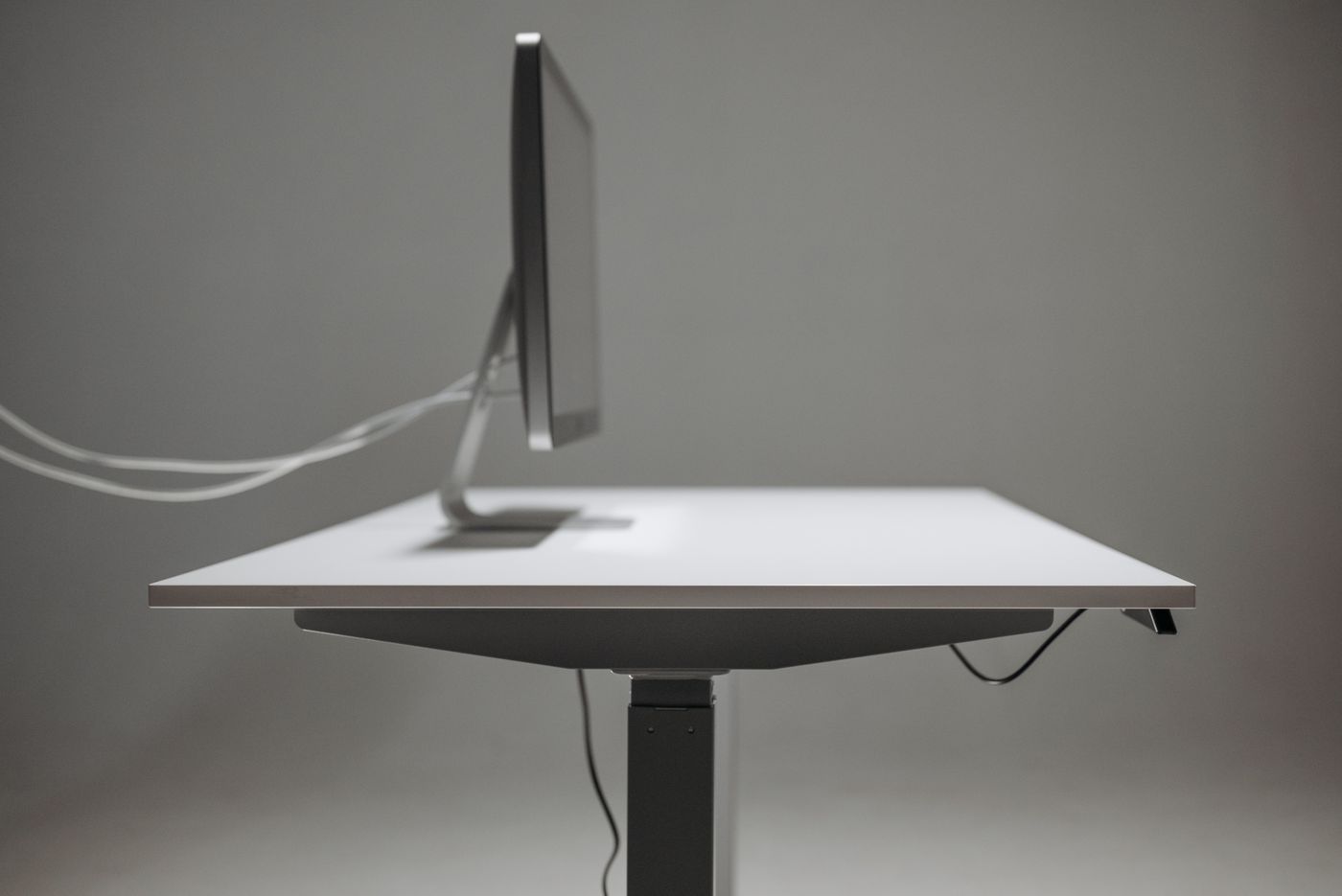
The 30-second answer: On a small desk you want a compact footprint (roughly 30” wide or less — tighter is better), a shallow depth that doesn’t overhang the back, a Z-lift or post-lift that rises straight up (so it doesn’t lunge toward you and eat desk depth), and a weight that won’t make a light desk unstable. Measure your desk first — depth is the silent dealbreaker.
The problem with putting a standing desk converter on a small desk is simple: most converters are built for big desks. They’re 31+ inches wide, deep enough to hang off the back edge, and heavy enough to make a compact desk feel cramped or tippy. Drop the wrong one onto a 40-inch desk and you’ve lost your whole working surface.
This guide answers one question: which converters actually fit a small desk without taking it over? Below are the dimensions that matter, a comparison table, and our picks for tight spaces — based on our analysis of specs and owner-feedback patterns.
Why small desks are harder for converters
Three things go wrong on a compact desk, and every pick below is judged against them:
- Depth overhang. Many converters need 20”+ of depth. On a shallow desk the base hangs off the back, which is unstable and blocks the wall. Shallow, straight-rising lifts win here.
- Width hogging. A 33”+ deck leaves no room for anything beside it. A deck around 30” or under keeps space for a notebook, mug, or a second small item.
- Tippiness. A heavy converter perched on a light, small desk raises the center of gravity. A balanced base and sane weight keep it planted.
How we picked
We weighted fit over raw feature count: deck width and depth, the lift path (straight-up Z-lift vs. arms that swing toward you), base stability on a smaller surface, weight relative to typical small desks, and whether owners with compact or shallow desks reported a clean fit rather than overhang. Marketing claims were ignored unless documented specs and owner reports supported them.
Quick comparison
| Pick | Best for | |
|---|---|---|
| FlexiSpot ClassicRiser M2B · Top Overall | Best for a Small Desk Overall | Check → |
| VIVO Compact Converter · Best Ultra-Compact | Best Ultra-Compact Pick | Check → |
| Ergotron WorkFit-Z Mini · Ultra Compact | Best for the smallest, shallowest desks | Check → |
| FEZIBO 30-inch Converter · Budget Compact | Best budget compact riser | Check → |
Our picks
FlexiSpot ClassicRiser M2B — Best for a Small Desk Overall
This one tops the list because its footprint stays compact while the lift rises straight up — so it doesn’t lunge forward and steal the desk depth you don’t have. It’s stable at full height without a sprawling base that overhangs a smaller desk.
- Compact deck that leaves usable desk space
- Straight Z-lift — minimal forward travel
- Stable at standing height
- Smaller top fits one monitor + laptop, not two big screens
- Less keyboard tray room
VIVO Compact Converter — Best Ultra-Compact Pick
If your desk is genuinely small or shallow, the smart move is the smallest stable footprint you can get — enough for a laptop or single monitor and a keyboard, nothing wasted. This pick keeps overhang to near zero.
- Smallest footprint here
- Near-zero back overhang
- Light enough not to destabilize a small desk
- Limited surface for accessories
- Lower weight capacity
Ergotron WorkFit-Z Mini — Best for the smallest, shallowest desks
The WorkFit-Z Mini uses a compact Z-shaped frame built for tight spaces, with hand-brake levers giving ~12.5 inches of click-free lift and the keyboard tray below the work surface for better posture. It’s rated to about 25 lbs and geared to a single monitor plus a laptop rather than a heavy dual-screen load.
- Genuinely small footprint for shallow desks
- Infinite, click-free height adjustment
- Keyboard tray sits below screen for posture
- Single-monitor oriented
- ~25 lb capacity limits heavier setups
FEZIBO 30-inch Converter — Best budget compact riser
FEZIBO’s 30-inch converter is a smaller two-tier riser with a pneumatic lift; collapsed, the keyboard tray sits only about a half-inch off the desk so a chair pulls right up. Owners note easy setup and solid value for apartment-sized desks. As a lighter unit, it’s best for a single monitor or a modest laptop setup.
- Small 30" width suits compact desks
- Near-flat collapsed height
- Budget-friendly
- Lighter build than premium risers
- Limited room for true dual-monitor use
What to look for (small-desk buyer’s checklist)
- Measure your desk depth first. If the converter’s base is deeper than your desk, it overhangs — the #1 small-desk mistake.
- Aim for ~30” deck width or less (≤27” if your desk is really tight). Keeps usable space beside it.
- Prefer a straight Z-lift or post-lift. Arms that swing toward you eat depth and feel tippy on a small surface.
- Check the collapsed height. A bulky converter sitting flat still steals headroom and visual space on a small desk.
- Match weight to your desk. A heavy converter on a flimsy small desk raises tip risk — keep it balanced.
Frequently asked questions
Will a standing desk converter fit a small desk? Yes, if you pick for footprint. The trap is depth: many converters overhang the back of a shallow desk. Measure your desk depth and match it to the converter’s base before buying.
How much desk space does a converter need? Plan for the converter’s full base dimensions plus a little clearance. On a small desk, a ~30”-or-under-wide deck with a shallow base leaves you room to actually work.
Should I get a converter or a small standing desk instead? If your desk is very small or unstable, a compact full standing desk may serve better than perching a converter on top. A converter wins when you want to keep your existing desk. See also converter vs. full standing desk.
Can a small converter hold a monitor and laptop? Many can, within their weight rating — but on the smallest decks you’ll fit one monitor or a laptop comfortably, not two big screens. For two screens, see our converter for dual monitors guide.
Do small converters feel less stable? Not inherently — a well-balanced compact base can be very stable. Tippiness usually comes from overhang or a heavy unit on a flimsy desk, both of which the checklist above avoids.
The verdict
On a small desk, the best converter is the one that fits without overhanging and rises straight up — not the one with the most features. Measure your desk depth, keep the deck around 30 inches or less, and favor a straight Z-lift. Get the fit right and you gain standing without losing your desk.
We analyze specs and owner-feedback patterns, and re-review this guide as new models are released. We never claim to have physically tested gear we haven’t. Prices and availability are shown live on Amazon via the links above.